How to Scrap a Car in the UK is an important topic for drivers who want to dispose of an unwanted, damaged, or end-of-life vehicle safely and legally. Scrapping your car through an authorised facility can help you avoid unnecessary complications while ensuring the vehicle is handled responsibly.
This guide explains How to Scrap a Car in the UK in 2026, from comparing quotes and choosing an Authorised Treatment Facility (ATF) to arranging collection and preparing the required paperwork. You will also learn about notifying the DVLA, understanding the Certificate of Destruction, and checking payment arrangements before handing over your vehicle. Knowing How to Scrap a Car in the UK can make the process easier, help you avoid common mistakes, and ensure you understand your responsibilities when removing a vehicle from the road.
This guide shows you how to scrap a car in the UK from start to finish. You will learn how to find a licensed Authorised Treatment Facility (ATF), how to protect your private number plate, and how to tell the DVLA so the car stops being your responsibility. Moreover, you will see what price to expect and which mistakes cost drivers money. We checked every step against GOV.UK guidance and the advice of leading UK scrap services, so you can follow along with confidence.
What’s on this page?
- How do I scrap my car?
- What our motor insurance expert says
- Can I keep my number plate if I’m scrapping my car?
- Can I strip my car for parts before scrapping it?
- Scrapping a car that’s registered abroad
- How much will I get to scrap my car?
- What documents will I need to scrap a car?
- If my car is a write-off, does that make a difference?
- What happens to my car insurance if I get rid of my car?
- Compare car insurance quotes
- Frequently asked questions
Key takeaways
- You can only scrap a car legally through a licensed ATF, which holds an Environment Agency permit.
- The ATF should issue a Certificate of Destruction (CoD) within seven days.
- You must tell the DVLA yourself, even when the scrap yard says it will do it. Failing to do so can bring a fine of up to £1,000.
- Notifying the DVLA is free, and your vehicle tax is cancelled once the record updates.
- Cash payments for scrap cars are illegal in England and Wales, so expect a bank transfer.
- Apply to keep a cherished registration before the car leaves your driveway.
- Most cars fetch roughly £150 to £300, although scrap metal prices change often.
How do I scrap my car?
Scrapping a car follows a clear path. Work through these actions in order and you will avoid fines, delays and nasty surprises.
- Check the car is yours to scrap. You must be the registered keeper. However, if the car is on finance, you need to clear the outstanding finance first, because the lender still owns the vehicle until then.
- Decide about your number plate.If you want to keep a personalised registration, apply to retain it before collection. The next section explains how.
- Gather your paperwork.Find your V5C logbook, photo ID and proof of address. A full list appears further down this page.
- Choose a licensed ATF. Only these sites can depollute and dismantle an end-of-life vehicle legally.Compare scrap car quotes. Enter your registration with two or three buyers. Prices differ more than most people expect.
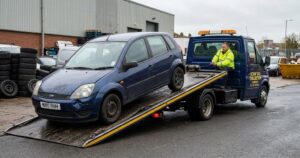
- Book collection or drop-off. Collection usually saves time. In fact, if your car has no MOT, tax or insurance, driving it to the yard is not an option because normal road rules still apply.
- Hand over the car and the V5C. Complete the scrapping section of your log book and follow the instructions printed on it. The layout changes slightly between versions, so read it carefully.
- Collect your Certificate of Destruction. An ATF issues this document once the car has been fully dismantled. Keep it safe as proof of scrapping.
- Notify the DVLA. Use the free online service with your registration number, the 11-digit V5C reference and the ATF’s name and address.
- Tell your insurer. Cancel or update your car insurance so you do not pay for a car that no longer exists.
More Read: Sell a car that failed its MOT without the stress
Here is a quick view of who handles each job.
| Task | You | ATF or scrap buyer |
| Settle finance | Yes | No |
| Retain private plate | Yes | No |
| Collect and depollute the car | No | Yes |
| Issue Certificate of Destruction | No | Yes |
| Notify the DVLA | Yes (always) | Often helps |
| Cancel insurance | Yes | No |
Several mistakes come up again and again, so watch for them:
- Trusting an unlicensed collector who offers cash and skips the paperwork.
- Forgetting to take personal items, toll tags and parking permits out of the car.
- Cancelling insurance before the car has actually left your property.
- Assuming the yard has told the DVLA, when the legal duty sits with you.
- Accepting a quote without asking whether the collection is really free.
Moreover, take dated photos of the car on collection day. They give you evidence of its condition and its removal if a dispute ever arises.
What our motor insurance expert says
Insurance causes more confusion than any other part of scrapping a car. Therefore, we pulled together the advice that matters most, based on how insurers and the DVLA treat scrapped vehicles.
First, scrapping a car does not cancel your policy automatically. You must contact your insurer and ask them to end or change the cover. Next, check whether you hold a no claims discount. Most providers let you keep it for a set period, so ask for written proof before you cancel.
Also, think about the dates. If you cancel mid-term, you may receive a partial refund, although insurers often deduct an admin fee and the days you were covered. Finally, do not cancel before the car has actually left. A car that stays on your drive can still be damaged or stolen, and you will want cover until the yard collects it.
Can I keep my number plate if I’m scrapping my car?
Yes, you can. Scrapping your car does not mean losing a cherished number plate. However, you must act before the car is destroyed.
- Apply to the DVLA to retain the registration while the car is still registered to you.
- Wait for your V778 retention certificate. It proves the registration is now yours to use.
- Scrap the car as normal, then assign the registration to another vehicle later.
Can I strip my car for parts before scrapping it?
You can, and some drivers earn extra cash this way. Nevertheless, a car that arrives with major parts missing may attract a lower price, or the ATF may refuse it. Scrap yards price a car on the assumption that it arrives complete.
| Part | Safe to remove? | Note |
| Stereo and sat nav | Yes | Easy to sell on |
| Alloy wheels | Yes | Tell the buyer before you quote |
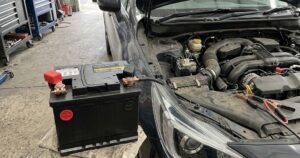
| Battery | Usually | Hazardous, so handle with care |
| Seats and trim | Yes | Tell the buyer first |
| Engine and gearbox | Not advised | Large drop in scrap value |
| Catalytic converter | Not advised | High theft risk, and removal lowers the quote |
| Airbags | No | Contain explosive charges |
| Fuel, oil and coolant | No | Leave this to trained staff |
Meanwhile, remember one rule. Parts you remove must go on another vehicle you own, or you must sell them lawfully. Moreover, always tell the scrap buyer exactly what you took. Honest descriptions keep your quote accurate and avoid arguments on collection day.
Scrapping a car that’s registered abroad
Scrapping a foreign-registered car in the UK is possible, but it needs extra checks. First, confirm the car is genuinely yours and that you hold its foreign registration documents. Then contact the registration authority in the car’s home country before you book anything.
This matters because of one important rule. If your vehicle was declared seriously damaged in its home country, you usually cannot register or tax it in the UK. Consequently, scrapping may become your only sensible option.
Many ATFs can process these cars and issue a Certificate of Destruction. Still, expect more questions about ownership and paperwork. Ask the yard what proof they need before you arrange the collection.
How much will I get to scrap my car?
Many cars fall between £150 and £300, although heavier models and cars with valuable parts can fetch more. Prices move because scrap yards pay by weight and sell the recovered metal at market rates. As a result, the same car can earn different amounts in different weeks.
| Factor | Effect on your quote |
| Weight of the car | Heavier cars usually pay more |
| Scrap metal prices | Rise and fall with the market |
| Make, model and age | Popular models have resale parts |
| Completeness | Missing parts reduce the offer |
| Alloy wheels and catalytic converter | Can lift the price |
| Location | Distance affects collection costs |
Here is how to get the best offer:
- Compare at least three quotes on the same day.
- Check that collection is free, because hidden fees eat into your payout.
- Mention alloy wheels and any extras honestly.
- Leave the car complete and tidy.
- Ask about payment timing, since reputable buyers pay on collection.
Also, watch out for one legal point. Under the Scrap Metal Dealers Act 2013, a dealer cannot pay cash for scrap in England and Wales. You should receive payment by bank transfer or cheque instead. A buyer who offers cash is a warning sign.
More Read: How to sell a damaged car and still get a fair price
What documents will I need to scrap a car?
Good preparation makes collection quick. In particular, have these items ready before the driver arrives.
| Document | Needed? | Why it matters |
| V5C logbook | Strongly advised | Shows you are the registered keeper |
| Photo ID | Yes | Dealers must verify who sells the car |
| Proof of address | Often | Confirms your details match the V5C |
| V778 retention certificate | Only if keeping the plate | Protects your registration |
| Service history | Optional | Helps buyers value the car |
| Spare keys | Optional | Some buyers pay slightly more |
What if you cannot find your log book? You can still scrap the car, but the process takes longer. Then write to the DVLA with your details, the registration, the collection date and the ATF’s name and address. Alternatively, you can apply for a replacement V5C before collection, which is usually simpler.
In addition, never hand over a car without a receipt or confirmation of collection. A written record protects you if anything goes wrong later.
If my car is a write-off, does that make a difference?
It can. When an insurer declares a car a write-off, it places the car in a salvage category. That category decides what happens next.
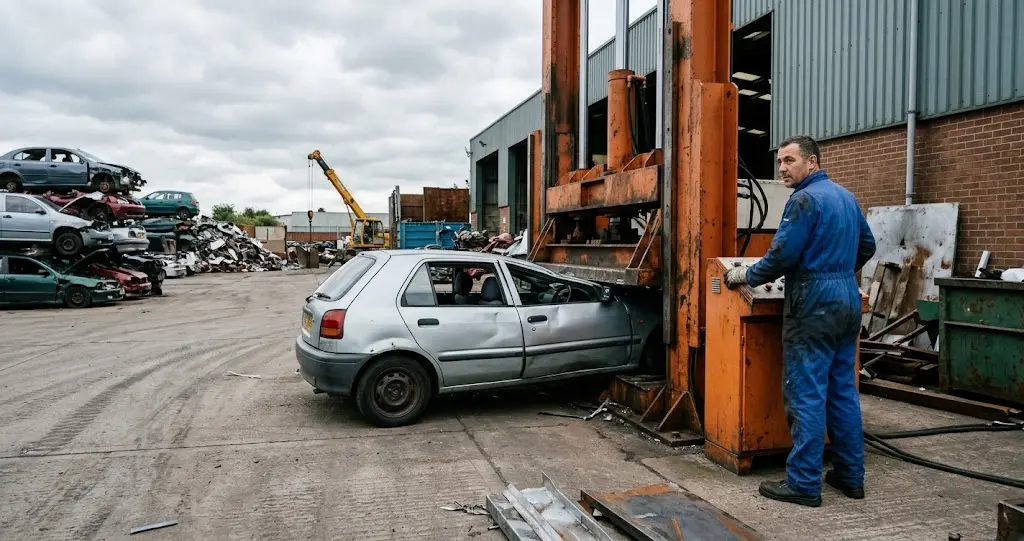
- Category A: The whole car must be crushed. Nothing is reusable.
- Category B: The body shell must be crushed, but some parts can be reused.
- Category S: The car is repairable, but the structure was damaged.
- Category N: The car is repairable, and the damage was non-structural.
Categories A and B must be scrapped, so an ATF is the right route. By contrast, Categories S and N can return to the road after proper repair and inspection. As a result, you may choose between repairing and scrapping.
Your insurer often arranges the scrapping when they take the car. Even then, you must notify the DVLA yourself. Otherwise, the car stays on your record, and you risk a fine. If your insurer offers a low settlement, you may be able to keep the car and sell it for salvage. Many drivers explore this option when the offer feels too low.
More Read: Sell a written off vehicle and compare your options
What happens to my car insurance if I get rid of my car?
Your motor insurance does not end by itself. What you must do depends on how the car leaves you.
If your car is written off
Your insurer handles the claim and pays a settlement based on the car’s market value. Therefore, the policy usually ends or moves to a replacement vehicle. Ask them to confirm this in writing. Then check your no claims bonus, because a fault claim can reduce it.
If you sell your car
Tell your insurer on the day of sale. Afterwards, cancel the policy or move the cover to your next car. Also keep a copy of the sale receipt. It proves the exact date you stopped being responsible for the vehicle.
If you scrap your car
Contact your insurer once the ATF has collected the car and you hold the Certificate of Destruction. Then cancel the policy and ask about any refund. Meanwhile, remember that your car tax stops automatically after the DVLA records the scrapping, and you may receive a refund for any full months left. If you pay by Direct Debit, it is cancelled for you.
Compare car insurance quotes
Once the old car has gone, you may need cover for its replacement. Therefore, compare car insurance quotes from several providers before you commit. Prices vary widely between insurers, and the cheapest option is not always the best value.
Have your new car’s registration, your licence details and your no claims proof ready. Also, check the excess, the cover level and any extras before you buy. A few minutes of comparison can save a surprising amount over a year.
Frequently asked questions
Can I scrap a car without a V5C logbook?
Yes, but you should write to the DVLA with the car’s details or apply for a replacement V5C first.
Do I have to notify the DVLA when I scrap my car?
Yes, you must notify the DVLA yourself, and a missed notification can bring a fine of up to £1,000.
How long does it take to scrap a car?
Collection often happens within a day or two, and the ATF issues your Certificate of Destruction within seven days.
Is it free to scrap a car?
Yes, reputable buyers collect for free and pay you for the vehicle, while the DVLA charges nothing to notify them.
Can I scrap a car without an MOT?
Yes, but you cannot legally drive it to the yard without valid MOT cover, so book a collection instead.
Can I scrap a car that is on finance?
No, you must settle the finance with your lender first because they still own the car.
Can I scrap a van or another vehicle the same way?
Yes, vans follow a very similar process, and you can arrange a scrap van collection in the same way.
Will I get a refund on my car tax?
Yes, the DVLA refunds any full months left on your tax from the date it receives your notification.
Do scrap buyers pay in cash?
No, cash payment for scrap vehicles is illegal in England and Wales, so you receive a bank transfer.
Conclusion
Scrapping a car in the UK is straightforward once you know the order of events. First, clear any finance and decide about your number plate. Next, gather your V5C and photo ID, then pick a licensed ATF. After collection, keep your Certificate of Destruction, notify the DVLA and update your insurer.
Most problems come from skipped steps, not from the process itself. For example, drivers forget to retain a cherished plate, or they trust the yard to tell the DVLA. Avoid both mistakes and you will finish cleanly.
If you live in the North West, you can book a free collection in Manchester with a licensed team that handles the DVLA paperwork for you. Otherwise, get a free scrap car quote in seconds by entering your registration online. Either way, you will leave the old car behind safely, legally and with money in your account.