How to Check If Your Car Fuse Is Blown is a useful skill for drivers who want to identify simple electrical problems before paying for unnecessary repairs. A blown fuse can cause issues with headlights, dashboard lights, power windows, radios, and other vehicle accessories. Learning the basic checks can help you narrow down the cause when an electrical component suddenly stops working.
This guide explains How to Check If Your Car Fuse Is Blown using a step-by-step approach, including locating the fuse box, inspecting the fuse, and testing it with a multimeter or fuse tester. Before starting, switch off the vehicle and consult your owner’s manual for the correct fuse information. Understanding How to Check If Your Car Fuse Is Blown can help you identify a faulty fuse safely and know when professional diagnosis is necessary.
In this guide, you will learn the warning signs, the safest way to test each fuse and the right way to swap it. Besides that, you will see UK repair costs for 2026 and learn when a bigger electrical fault needs a professional. If you drive an older car, you will also see when repairs stop making sense.
What’s in this article
- Why a fuse box stops working
- Signs your car’s fuse box has problems
- How to fix a non-working fuse box
- Repair costs in the UK for 2026
- What the experts say
- Whether a car fuse box is worth fixing
- Frequently asked questions
Why does a fuse box stop working?
A fuse box protects the electrical system of your car. Each fuse holds a thin metal strip called a filament. When too much current flows through it, the strip melts and cuts the circuit. That small sacrifice saves your wiring, your stereo and your engine control unit from serious damage.
So why does a fuse give up in the first place? Most failures trace back to a handful of causes.
- Overload: You plug in too many gadgets, or a charger draws more power than the circuit allows.
- Short circuit: A worn wire touches the metal body of the car and sends a sudden surge through the line.
- Wrong fuse rating: Someone fitted a fuse with the wrong amperage rating, so it fails early or fails to protect.
- Corrosion and moisture: Water in the fuse box rusts the terminals and causes poor contact.
- Ageing parts: Heat and vibration weaken fuses and sockets over many years.
- Faulty accessories: A failing fuel pump, window motor or aftermarket dash cam can pull too much current.
However, a single blown fuse rarely tells the whole story. If the same fuse keeps failing, a deeper fault is hiding in that circuit. In that case, swapping the part again and again will not solve anything.
Signs your car’s fuse box has problems
Some symptoms shout at you. Others whisper. Learning both types helps you catch trouble early.
Obvious signs
These signs appear fast and are hard to miss.
- The power windows stop moving.
- The headlights, indicators or brake lights go dark.
- The radio or infotainment screen refuses to switch on.
- The 12V socket no longer charges your phone.
- The wipers or heater fan stay silent.
- A warning light appears on the dashboard.
- The central locking fails to respond.
Also, look for a faint burnt plastic smell near the dashboard. That odour often means a fuse blew recently or a wire is overheating.
More Read: Sell a damaged car in the UK
Subtle warning signs
These clues are easy to ignore, but they matter just as much.
- Flickering lights that come and go on bumpy roads.
- Gadgets that work for a minute and then cut out.
- A fuse that looks fine but feels hot to the touch.
- Discolouration or melted plastic around a fuse slot.
- Random electrical glitches after rain or a car wash.
- A flat battery overnight, which can signal a parasitic drain.
In fact, these small hints often show up weeks before a full failure. Therefore, check the fuse box as soon as you notice a pattern.
How to fix a non-working fuse box
You do not need a garage for this job. Most cars have two fuse boxes. One sits under the bonnet, and the other hides under the dashboard or inside the glove box. Your owner’s manual shows the exact spot and includes a fuse diagram.
Before you start, gather these items:
- A fuse puller or small needle-nose pliers
- A multimeter or a test light
- A box of spare blade fuses in common sizes
- A torch
- Your car’s manual
Meanwhile, park on flat ground, apply the handbrake and keep the area dry.
1. Power off the supply.
Safety comes first. Turn the ignition off and remove the key. Next, switch off every light and accessory. For extra safety, disconnect the negative battery terminal with a spanner. This step prevents sparks and protects the sensitive electronics in modern cars.
Besides that, wear dry gloves and avoid metal jewellery. Never work on the fuse box with wet hands.
2. Identify the problem fuse or component.
First, open the fuse box cover. The inside of the lid usually shows a map that links each slot to a part, such as the radio or the wipers. Match the broken part to its fuse. Then you can test only the right one instead of checking them all.
You have three simple ways to test it.
Visual check
Pull the fuse out with the fuse puller. Hold it up to the light and look through the clear plastic. A healthy fuse shows an unbroken metal strip. A blown fuse shows a gap, a black burn mark or a melted blob inside.
Test light method
Turn the ignition to the accessory position. Clip the test light to a bare metal bolt for a ground. Touch the probe to the two small metal test points on top of each fuse. Both points should light the bulb. If only one side lights up, the fuse has blown.
Multimeter method
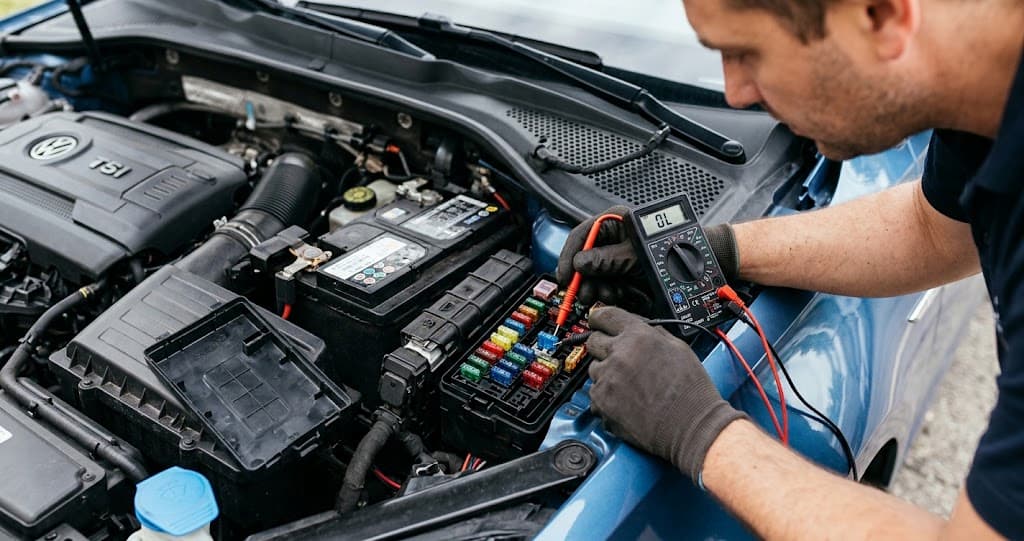
Set your multimeter to the continuity mode, which often shows a sound icon. Remove the fuse and touch one probe to each blade. A beep means the fuse is good. Silence means the metal strip is broken. Alternatively, you can test it in place by setting the meter to voltage and checking both test points. A reading of about 12 volts on both sides means the fuse works.
More Read: Sell your MOT failure car
3. Replace the fuse (if that’s the issue).
Once you spot the dead fuse, grip it with the puller and pull it straight out. Read the number printed on top. That number shows the amp rating, such as 10A or 20A. Then choose a new fuse with the same rating and the same size.
Colour also helps. Standard blade fuses follow a code.
| Colour | Amp rating | Typical use |
| Tan | 5A | Small sensors, interior lights |
| Red | 10A | Radio, indicators |
| Blue | 15A | Wipers, cigarette lighter |
| Yellow | 20A | Power windows, sunroof |
| Clear | 25A | Heated seats, fuel pump |
| Green | 30A | Air conditioning, heater blower |
Push the new fuse firmly into the empty slot. Never use a higher rating, a coin or a piece of foil. A bigger fuse lets too much current through, so the wires heat up instead of the fuse. As a result, you risk a vehicle fire.
4. Restore power and test.
Reconnect the battery and refit the fuse box cover. Next, turn the ignition on and try the part that failed. If it springs back to life, you are done.
Still, keep an eye on it for a few days. Should the new fuse blow again straight away, stop. A repeat failure points to a short circuit or a faulty component. At this point, an auto electrician should trace the wiring with proper diagnostic gear.
For tips on the legal checks that keep your car road ready, you can browse the <a href=https://www.gov.uk/check-mot-history rel=nofollow target=_blank>GOV.UK MOT history service</a> and review past electrical advisories.
Get an instant quote for your scrap car
Sometimes the fuse is only the first of many faults. Maybe the wiring loom is damaged, the car failed its MOT or repair bills now beat the car’s value. In that case, you can skip the stress and sell the car for scrap.
Scrap My Car UK offers a simple process.
- Enter your registration number online.
- Receive an instant quote with no obligation.
- Book free same day collection where available.
- Get paid by bank transfer when the car leaves.
The team also handles the DVLA paperwork, so you do not need to chase forms. Whether your car is a non-runner, accident damaged or simply too old, you can get a price in seconds. If you drive a commercial vehicle, you can also scrap your van with the same quick service.
More Read: Sell a written off vehicle
How much does it cost to repair a car fuse box or breaker panel?
Costs vary widely. A simple fuse swap costs almost nothing. However, a full fuse box replacement can reach several hundred pounds because the part is complex and the labour takes time. The figures below are typical UK estimates, so always confirm a quote with your garage.
Replacement costs by component
- Single blade fuse: under £1 each
- Assorted fuse kit: about £3 to £10
- Relay: about £8 to £40 per part
- Fuse box cover or lid: about £10 to £45
- Complete fuse box unit: about £80 to £450 for the part alone
- Wiring repair: often £60 to £250, depending on access
Fuse box component replacement costs (UK, 2026)
| Component | Part cost | Labour cost | Typical total |
| Blade fuse | £0.50 to £1 | £0 (DIY) or £15 to £30 | £1 to £30 |
| Relay | £8 to £40 | £30 to £70 | £40 to £110 |
| Fuse box cover | £10 to £45 | £20 to £40 | £30 to £85 |
| Wiring section repair | £5 to £40 | £60 to £200 | £65 to £240 |
| Complete fuse box unit | £80 to £450 | £90 to £250 | £170 to £700 |
| Diagnostic test | n/a | £45 to £100 | £45 to £100 |
Luxury and electric models sit at the top of these ranges. For example, a modern body control module with a built-in fuse box can cost much more than a basic hatchback unit.
Factors affecting car fuse box replacement costs
Several details change the final bill.
- Make and model: Premium brands charge more for parts.
- Fuse box location: A box buried behind the dashboard adds labour hours.
- Part type: Genuine parts cost more than used or aftermarket ones.
- Programming needs: Some units need coding to the car, which adds a software fee.
- Garage rates: Hourly prices differ between independent garages and main dealers.
- Extent of damage: Water or fire damage may affect nearby wiring too.
Likewise, your location matters. Garages in London and the South East often charge more per hour than those in the North.
DIY vs professional costs
| Option | Typical cost | Time needed | Best for |
| DIY fuse swap | £1 to £10 | 10 to 20 minutes | Single blown fuse |
| DIY relay swap | £10 to £45 | 20 to 40 minutes | Clicking or dead relay |
| Independent garage | £45 to £700 | 1 to 4 hours | Repeat failures, wiring faults |
| Main dealer | £120 to £900 | 1 to 5 hours | Newer cars, warranty work |
On the whole, DIY works well for a single fuse. Nevertheless, hand the job to a pro if you smell burning, see melted wires or face repeat failures.
More Read: Sell a salvage car
What the experts say
Professional auto electricians agree on a few core rules. First, always match the fuse rating exactly. Second, never bypass a fuse to make a part work. Third, treat a repeat failure as a symptom rather than the problem. Besides that, most experts urge drivers to disconnect the battery before opening any fuse box on a hybrid or electric car, because these models carry high voltage systems.
Many technicians also stress prevention. For instance, they suggest keeping a small spare fuse kit in the glove box and checking the fuse box for damp every year.
Steven Jackson OBE
<!– Add a verified, attributed quote or statement from Steven Jackson OBE here before publishing. No quote has been invented. –>
Industry leaders in vehicle recycling and road safety often highlight one point. Small electrical faults can grow into costly or even dangerous problems when drivers ignore them. Therefore, early checks and the correct parts protect both your wallet and your safety.
Is a car fuse box worth fixing or replacing?
In most cases, yes. A fuse swap takes minutes and costs almost nothing. Even a relay or cover replacement costs far less than the loss of a working car. Overall, repairs make sense when the car is otherwise reliable.
Yet the picture changes for older vehicles. Consider these questions before you spend money.
- Does the repair cost more than half the car’s value?
- Has the car failed its MOT for other major issues?
- Is rust or water damage spreading through the wiring harness?
- Do you face the same electrical fault again and again?
- Is the car a non-runner that needs a lot of work?
If you answer yes to several, selling the car may save money. Once you get a valuation, you can compare it with the repair quote and decide with confidence. Moreover, you can sell cars in any condition, including a car with a damaged fuse box.
Also, living in a big city makes this easy. For example, you can scrap a car in Manchester or London with local collection teams. For more motoring advice, visit the Scrap My Car UK blog.
Frequently asked questions
How do I know if a car fuse is blown?
Pull the fuse and look for a broken metal strip or burn mark, or test it with a multimeter.
Where is the fuse box in most cars?
Most cars have one under the bonnet and another under the dashboard or in the glove box.
Can I check a fuse without removing it?
Yes, you can touch a multimeter or test light to the two test points on top of the fuse.
What happens if I use the wrong fuse?
A wrong rating can overheat the wires and cause damage or even a fire.
Why does my car fuse keep blowing?
Repeat failures usually mean a short circuit, an overloaded circuit or a faulty part.
How much does a replacement car fuse cost?
A single blade fuse costs under £1, and a kit costs about £3 to £10.
Can I drive with a blown fuse?
You can drive only if the fuse does not control safety items like lights, brakes or wipers.
How long does it take to replace a car fuse?
Most drivers finish the job in 10 to 20 minutes.
About : scrapmycaruk.com
Scrap My Car UK is a licensed scrap car buyer that offers instant quotes, free collection and full DVLA paperwork support across the UK. Call 0161 883 3074 or visit the About Us page to learn more.
Can You Sell a SORN Car in the UK?
Yes, you can sell or scrap a SORN car, and the buyer can collect it from your property.
Wins the 2026 King’s Award for Enterprise for Innovation
Add your verified award details here before publishing.
How Do I Scrap My Van in the UK?
Enter your registration number online and book free van collection.
Helpful tools
Free car valuation
Get an instant price for your vehicle through the quote form.
Car finance calculator
Estimate monthly payments before you replace your old car with a newer one.