A car transmission is one of the most important components of a vehicle’s drivetrain. It transfers power from the engine or electric motor to the wheels, allowing the vehicle to accelerate, slow down, climb hills and maintain a steady speed. Without a properly functioning transmission, a car cannot deliver power efficiently under different driving conditions.
But what is a transmission in a car, and how does it actually work? In simple terms, the transmission controls how engine power reaches the wheels by adjusting gear ratios. Lower gears provide more pulling power at slower speeds, while higher gears allow the vehicle to travel faster with lower engine RPM.
You may also hear the terms gearbox, drivetrain and transmission system used interchangeably. Although they are closely related, they do not always mean exactly the same thing. A gearbox contains the gears that control power and speed, whereas the transmission system includes other components responsible for transferring engine power.
How Does a Car Transmission Work?
A car transmission works by controlling the relationship between engine speed and wheel speed. It changes the gear ratio to provide the right amount of torque for different driving situations.
For example, when you start moving from a complete stop, your vehicle needs more torque to overcome resistance. The transmission uses a lower gear to multiply engine torque, helping the wheels turn with sufficient force.
As the vehicle gains speed, the transmission shifts into higher gears. This reduces engine RPM and helps maintain a comfortable cruising speed.
The basic process involves several steps:
- The engine generates power through combustion, or an electric motor produces rotational force.
- Power travels through the clutch or torque converter, depending on the transmission design.
- The transmission selects an appropriate gear ratio.
- The output shaft transfers power towards the final drive and differential.
- The differential distributes torque to the driven wheels.
- The wheels rotate and move the vehicle forward or backwards.
Modern vehicles use different transmission designs to manage this process. Some require drivers to change gears manually, while others use electronic controls to select the appropriate ratio automatically.
What Is a Manual Transmission and How Does It Work?
A manual transmission is a gearbox that allows drivers to select gears themselves using a gear lever and clutch pedal. It gives the driver direct control over when to change gears and how engine power is delivered.
Most modern manual vehicles have five or six forward gears, along with neutral and reverse. However, the exact number of gears depends on the vehicle.
How a Manual Gearbox Transfers Power
A manual gearbox uses several mechanical components to transfer engine power to the wheels.
Here’s how the process works:
- Engine power generation: The engine rotates the flywheel and clutch assembly.
- Clutch engagement: Releasing the clutch pedal connects the engine to the gearbox input shaft.
- Gear selection: The driver selects a gear that determines the transmission ratio.
- Power transfer: The selected gear transfers torque through the transmission’s internal shafts.
- Final drive: Power passes through the differential and drive axles.
- Wheel movement: The driven wheels rotate and move the vehicle.
When you press the clutch pedal, the clutch temporarily disconnects the engine from the gearbox. This allows you to change gears without forcing rotating components together.
As you release the pedal, the clutch reconnects the engine and transmission. Smooth clutch operation helps prevent unnecessary wear, clutch slipping and harsh gear engagement.
Advantages of Manual Transmissions
Manual gearboxes remain popular because they offer several benefits:
- Greater control over gear selection.
- Relatively simple mechanical construction.
- Often lower purchase and repair costs.
- An engaging driving experience.
- Good fuel economy in suitable vehicle designs.
However, manual transmissions require more driver involvement, particularly in heavy traffic. Incorrect clutch operation can also cause premature wear to the clutch disc, pressure plate and release bearing.
Different Types of Car Transmissions
Vehicle manufacturers use several transmission designs depending on performance requirements, driving comfort, fuel efficiency and manufacturing costs.
Understanding these transmission types can help you choose a vehicle that suits your driving habits and maintenance budget.
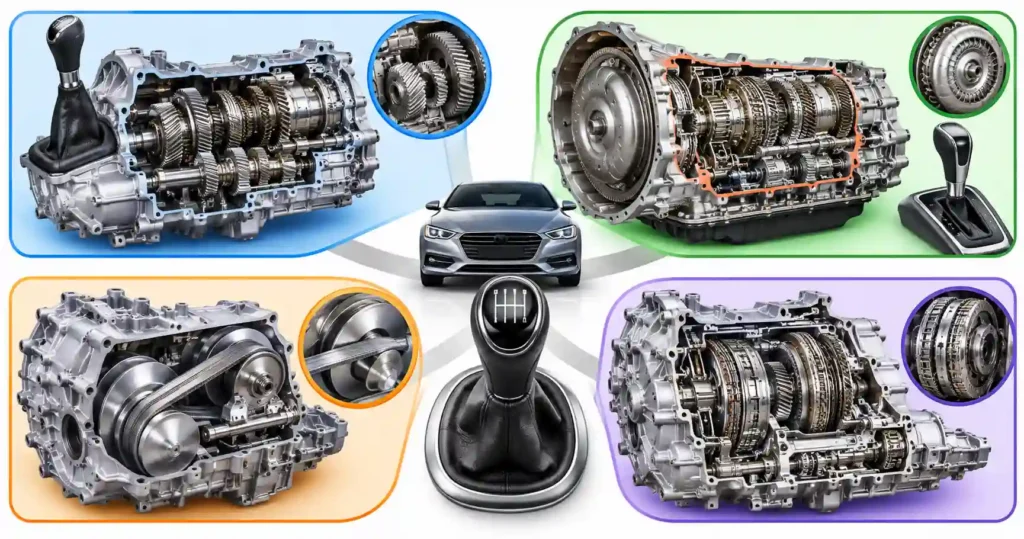
| Transmission Type | How It Works | Main Advantages | Common Limitations |
| Manual | Driver selects gears using a clutch and gear lever | Control and mechanical simplicity | Requires more driver effort |
| Conventional Automatic | Uses a torque converter and planetary gearsets | Smooth driving and convenience | Complex components and maintenance |
| CVT | Uses variable pulleys connected by a belt or chain | Smooth acceleration and flexible ratios | Specific fluid and servicing requirements |
| Dual-Clutch (DCT) | Uses two clutches to control separate gear groups | Fast gear changes | Complex and potentially expensive repairs |
| Automated Manual (AMT) | Uses actuators to operate a manual clutch and gearbox | Automatic convenience with manual hardware | Can produce noticeable shift interruptions |
| Synchronized Manual | Uses synchronizers to match gear speeds | Easier and quieter gear changes | Synchronizer wear can affect shifting |
| Unsynchronized Manual | Requires rotating speeds to be matched during gear changes | Simple and robust construction | More difficult to operate smoothly |
Let’s look at how these transmission systems work and where each one is commonly used.
1. Dual-Clutch Transmission (DCT)
A dual-clutch transmission, commonly known as DCT or DSG, uses two separate clutches to control different groups of gears.
One clutch generally handles odd-numbered gears, while the other manages even-numbered gears and reverse. The exact arrangement can vary between manufacturers.
While one gear is transferring power, the transmission can prepare the next suitable gear in advance. It then transfers power between the two clutches, allowing rapid gear changes with minimal interruption.
Benefits of a DCT:
- Fast and responsive gear changes.
- Efficient power delivery.
- Improved driving performance in suitable applications.
- Reduced interruption during acceleration.
Potential disadvantages:
- More complicated mechanical and electronic systems.
- Potentially expensive repairs.
- Low-speed hesitation in some models.
- Additional clutch demands in stop-start traffic.
DCT systems are particularly popular in vehicles designed to provide sporty performance alongside automatic driving convenience.
2. Unsynchronized Transmission
An unsynchronized transmission does not use synchronizer mechanisms to match the rotational speeds of gears before engagement.
Instead, the driver must carefully match the speeds using throttle control, timing or double-clutching.
This design was common in older vehicles and is still used in certain heavy-duty and specialist applications.
Although unsynchronized gearboxes can offer robust mechanical construction, they require more driving skill. Forcing the gear lever into position can create grinding noises and damage internal engagement components.
3. Synchronized or Constant-Mesh Transmission
A synchronized transmission uses synchronizer rings or cones to match the rotational speeds of the gear and shaft before engagement.
This makes changing gears smoother and easier than using an unsynchronized gearbox.
In a constant-mesh design, gear pairs remain engaged with each other. A synchronizer collar selects the appropriate gear and connects it to the output shaft.
Common benefits include:
- Smoother gear changes.
- Reduced gear engagement noise.
- Easier everyday driving.
- Improved shifting comfort.
However, worn synchronizers can cause grinding noises, stiff gear selection or difficulty engaging particular gears.
Low or incorrect gearbox oil can also increase friction and contribute to premature internal wear.
For more information about transmission maintenance, read our guide to Gearbox Oil Leak Symptoms: 7 Warning Signs to Watch For.
4. Automated Manual Transmission (AMT)
An automated manual transmission uses the mechanical design of a conventional manual gearbox but automates clutch operation and gear selection.
Instead of operating a clutch pedal and gear lever, the driver allows electronic controls and actuators to manage gear changes.
Sensors monitor information such as:
- Engine speed.
- Vehicle speed.
- Throttle position.
- Brake application.
- Transmission temperature.
The transmission control unit uses this information to determine when to disengage the clutch, select another gear and reconnect the engine.
Advantages of AMT systems:
- Automatic driving convenience.
- Mechanical similarities to manual gearboxes.
- No conventional clutch pedal.
- Potentially lower manufacturing costs than some full automatic designs.
Limitations:
Some AMTs produce noticeable pauses, hesitation or slight jolts during gear changes. This behaviour can be more noticeable during rapid acceleration or slow-moving traffic.
5. Single-Clutch Transmission
A single-clutch transmission uses one clutch to connect the engine to the gearbox.
In a conventional manual vehicle, the driver operates the clutch. In a single-clutch automated manual system, electronic actuators manage the clutch automatically.
The design is relatively straightforward compared with dual-clutch systems.
However, because only one clutch controls the power connection, gear changes can create a noticeable interruption in power delivery.
6. Preselector Transmission
A preselector transmission allows the next gear to be selected or prepared before the actual gear change takes place.
Older preselector systems used separate controls to prepare the next ratio before a clutch or another mechanism completed the change.
The underlying idea is also relevant to modern automated transmissions, which can prepare an expected gear before changing ratios.
However, historical preselector transmissions and modern dual-clutch systems use different mechanical arrangements and should not be confused.
How Does an Automatic Transmission Work?
An automatic transmission changes gears without requiring the driver to operate a clutch pedal or manually select each gear.
Most conventional automatic vehicles provide four main driving selections:
- Park (P): Locks the transmission output to help prevent vehicle movement.
- Reverse (R): Allows the vehicle to move backwards.
- Neutral (N): Disconnects the transmission’s drive connection.
- Drive (D): Allows the transmission to select gears automatically.
Traditional automatic transmissions commonly use a torque converter, planetary gearsets, hydraulic circuits, clutches, sensors and an electronic control unit.
Understanding the Main Components
Torque Converter: The torque converter transfers engine power through transmission fluid. It allows the engine to continue running while the vehicle is stationary. Many modern systems also include a lock-up clutch to reduce slip during cruising.
Planetary Gearsets: These gearsets create different transmission ratios by controlling the movement of their internal components.
Hydraulic System: Transmission fluid pressure operates internal clutches and brakes to engage the required gears.
Transmission Control Unit: The electronic control unit monitors driving conditions and manages gear changes.
How Automatic Gear Changes Happen
The gear-changing process generally follows these steps:
- Sensors monitor engine speed, vehicle speed, throttle position and driving load.
- The transmission control unit analyses the available information.
- Solenoids regulate hydraulic pressure.
- Internal clutches and brakes control the planetary gearsets.
- The transmission changes to the appropriate ratio.
- Hydraulic pressure is adjusted to maintain smooth operation.
Automatic transmissions make everyday driving easier, especially in busy urban areas. However, they contain several interconnected mechanical, hydraulic and electronic components.
Using the correct automatic transmission fluid and following the manufacturer’s maintenance schedule are essential for long-term reliability.
Common Automatic Transmission Problems
A faulty automatic gearbox may produce several warning signs, including:
- Delayed engagement when selecting Drive or Reverse.
- Slipping gears during acceleration.
- Harsh or unexpected gear changes.
- Unusual whining or grinding noises.
- Transmission overheating.
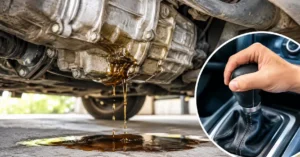
- Fluid leaks underneath the vehicle.
- Dashboard transmission warning lights.
These symptoms do not necessarily indicate one specific fault. A professional inspection can help identify whether the problem involves fluid pressure, internal components, sensors or electronic controls.
If repairing an older vehicle becomes too expensive, you can also read our guide: Should You Sell Your Car or Scrap It? UK Guide 2026.
You can also explore our Scrap My Car UK service if repairing your vehicle is no longer financially worthwhile.
What Is a Continuously Variable Transmission (CVT)?
A continuously variable transmission, commonly called a CVT, is an automatic transmission that provides a continuous range of gear ratios rather than relying on a fixed set of conventional gears.
Most CVTs use two variable-diameter pulleys connected by a strong metal belt or chain.
As the pulley diameters change, the belt or chain moves between different positions. This changes the transmission ratio and allows the engine to operate at a suitable speed for the driving conditions.
How a CVT Works
Unlike traditional automatic transmissions, which shift between individual gear ratios, a CVT adjusts its ratio continuously.
For example, when accelerating, the transmission changes the pulley positions to provide the appropriate balance between engine speed and wheel speed.
This can help maintain smooth acceleration without noticeable gear changes.
Some manufacturers also programme simulated gear steps into their CVT systems to create a more familiar driving experience.
Benefits of CVT Transmissions
- Smooth acceleration without traditional gear shifts.
- Flexible gear ratios.
- Potential fuel-efficiency benefits.
- Comfortable driving in urban traffic.
- Ability to keep the engine within an efficient operating range.
Disadvantages of CVT Transmissions
- Some drivers dislike the engine noise during acceleration.
- Certain repairs can be expensive.
- Requires manufacturer-approved transmission fluid.
- Can develop shuddering, whining or delayed engagement when faulty.
CVT performance and reliability depend on the vehicle design, maintenance history and driving conditions. Always follow the manufacturer’s servicing recommendations and use the specified transmission fluid.
Which Type of Transmission Is Best for Your Car?
There is no single transmission type that is best for every driver. Your choice should depend on your driving habits, budget, vehicle requirements and maintenance expectations.
| Transmission Type | Best Suited For | Main Consideration |
| Manual | Drivers who prefer direct control | Clutch operation and driver effort |
| Automatic | Everyday commuting and busy traffic | Maintenance and repair costs |
| CVT | Smooth urban driving | Correct fluid and servicing |
| DCT | Performance-focused driving | Clutch and electronic system complexity |
| AMT | Drivers seeking basic automatic convenience | Gear-change smoothness |
Before purchasing a used vehicle, check its service history and look for evidence of regular transmission maintenance. A test drive can also help identify unusual noises, delayed engagement or shifting problems.
How to Maintain Your Car Transmission
Regular maintenance can help extend transmission life and reduce the risk of expensive repairs.
Here are some practical steps to protect your gearbox:
- Check Transmission Fluid
Transmission fluid lubricates moving components, helps control temperature and supports hydraulic operation in many automatic systems. Check fluid condition and level according to the manufacturer’s instructions.
- Use the Correct Transmission Fluid
Different transmission designs require different fluid specifications. Using the wrong product can affect lubrication, hydraulic pressure and component performance.
- Avoid Aggressive Driving
Repeated hard acceleration, excessive loads and harsh gear changes can increase stress on transmission components.
- Respond to Oil Leaks Quickly
A transmission fluid leak can lead to insufficient lubrication, overheating and internal damage. Arrange an inspection if you notice fluid underneath your vehicle.
- Follow the Manufacturer’s Service Schedule
Some transmissions require regular fluid changes, while others have specific inspection or maintenance procedures. Always follow the recommendations for your vehicle.
- Investigate Unusual Symptoms
Grinding, slipping, delayed gear engagement and unexpected warning lights should not be ignored. Early diagnosis may prevent a relatively minor problem from becoming a major repair.
Frequently Asked Questions About Car Transmissions
1. What Is a Transmission in a Car?
A transmission is a mechanical or electronically controlled system that transfers power from the engine or electric motor to the wheels. It adjusts gear ratios to provide the torque and speed needed for different driving conditions.
2. What Does a Transmission Do in a Vehicle?
A transmission controls how engine power reaches the wheels. It helps the vehicle accelerate, move from a standstill, climb hills, reverse and maintain cruising speeds efficiently.
3. What Is the Difference Between a Manual and Automatic Transmission?
A manual transmission requires the driver to operate a clutch pedal and select gears using a gear lever. An automatic transmission uses electronic and mechanical controls to change gears without manual clutch operation.
4. How Does an Automatic Transmission Work?
A conventional automatic transmission uses a torque converter, planetary gearsets, hydraulic pressure, clutches and electronic controls to select suitable gear ratios according to driving conditions.
5. Is a Gearbox the Same as a Transmission?
Not exactly. A gearbox generally refers to the gear mechanism, while a transmission describes the wider power-transfer system and may include the clutch, torque converter, fluid circuits and control components.
6. Which Transmission Is Best for City Driving?
Automatic and CVT transmissions can be convenient for city driving because they reduce the need for manual gear changes. However, the best option depends on vehicle reliability, maintenance costs and personal preference.
7. What Are the Warning Signs of a Failing Transmission?
Common warning signs include slipping gears, delayed engagement, grinding noises, harsh shifting, overheating, fluid leaks and dashboard warning lights. These symptoms should be checked by a qualified technician.
8. Do Electric Cars Have Transmissions?
Yes. Most electric vehicles use a single-speed reduction gearbox instead of a conventional multi-speed transmission. However, some electric and hybrid vehicles use more complex transmission arrangements.
9. Can a Faulty Transmission Reduce a Car’s Value?
Yes. Transmission problems can significantly reduce a vehicle’s resale value because potential buyers may need to pay for diagnosis, repairs or replacement. The severity of the fault and the vehicle’s overall condition also matter.
10. How Long Does a Car Transmission Last?
Transmission lifespan varies according to vehicle design, driving conditions, maintenance history and usage. Regular servicing and early attention to warning signs can help reduce unnecessary wear.
11. Can You Drive With a Transmission Oil Leak?
Driving with a transmission oil leak is not recommended without first establishing its severity. Low fluid levels can cause overheating, poor lubrication and serious internal damage. Arrange an inspection and follow professional advice before continuing to drive.
For practical advice after an MOT failure, read If My Car Failed Its MOT, Can I Still Drive It? UK Rules Explained.
If your older vehicle has developed several problems, our guide to Why Winter Is the Best Time to Scrap Your Car may also help you consider your options.
Conclusion
A car transmission plays a vital role in transferring engine power to the wheels and controlling how a vehicle performs at different speeds. Whether your car has a manual gearbox, conventional automatic, CVT, DCT or AMT, the transmission must work correctly to deliver smooth and reliable driving performance.
Each transmission type has its own advantages and limitations. Manual systems offer direct control, conventional automatics provide convenience, CVTs deliver continuously variable ratios, and dual-clutch systems support fast gear changes.
Understanding these differences can help you make better decisions when purchasing, maintaining or repairing a vehicle.
Regular maintenance, correct transmission fluid and early attention to warning signs can help prevent avoidable damage. If your gearbox develops unusual noises, leaks, slipping or shifting problems, arrange a professional inspection before the issue becomes more expensive.
For major transmission faults, compare the estimated repair cost with your vehicle’s current market value before deciding whether to repair, sell or scrap it.