Ever wondered how your car stays stable on uneven roads while delivering a comfortable ride? The Car Suspension System plays a vital role in controlling vehicle movement, absorbing road impacts, and keeping tyres in contact with the road. From shock absorbers and springs to control arms and struts, every component contributes to driving comfort, handling, and safety.
Understanding the Car Suspension System helps drivers recognise how different suspension types work and why regular maintenance matters. This guide explains the main suspension types, essential parts, and their functions in simple terms. Whether you are learning about vehicle mechanics or checking your car’s condition, exploring the Car Suspension System will help you understand what keeps your vehicle balanced, stable, and road-ready.
Every time your car hits a pothole, takes a roundabout at speed, or rolls over a speed bump, the suspension does the hard work out of sight. Most drivers only notice it when something goes wrong, such as a bouncy ride, a steering wheel that pulls to one side, or a knocking sound over bumps. This guide explains how a car suspension system works, the main suspension parts, the common types of suspension, and the warning signs that your setup needs attention. Whether you drive a daily commuter, a family SUV, or an older car you are thinking of getting rid of, understanding the suspension helps you make safer and cheaper decisions.
How Car Suspension Systems Work: Types, Components and Why They Matter?
What Is a Car Suspension?
A car suspension is the group of parts that connects the wheels to the vehicle body and controls how the car moves over uneven ground. Without it, every bump would travel straight into the cabin, and the tyres would lose contact with the road at the worst possible moment. The suspension has three core jobs. It supports the weight of the vehicle, it keeps the tyres pressed onto the road surface, and it absorbs energy from bumps so passengers feel a smoother ride.
What Is a Suspension System in Practical Terms?
In practical terms, the suspension system is a team of springs, dampers, arms, joints, and rubber bushes that work together. The wheels and tyres form the outer layer because they are the only parts that touch the ground. Behind them, the suspension holds each wheel in position while letting it move up and down. Engineers tune this balance between ride comfort and road holding for every model. A soft setup feels comfortable but can wallow in corners. A stiff setup feels sharp and sporty but can rattle you on broken roads.
How Car Suspension Works
When a wheel hits a bump, it moves upwards and the spring compresses, storing that energy. The spring then wants to push back, which could make the car bounce for a long time. This is where the shock absorber steps in. It slows that movement by forcing hydraulic fluid through small valves, which turns the energy into a small amount of heat. As a result, the body settles quickly instead of bouncing. Put simply, springs absorb the impact and dampers control what happens afterwards. Meanwhile, the control arms guide the wheel so it stays upright and in contact with the road. This whole process repeats many times per second, which is why a healthy suspension feels effortless to most drivers.
Main Components of a Suspension System
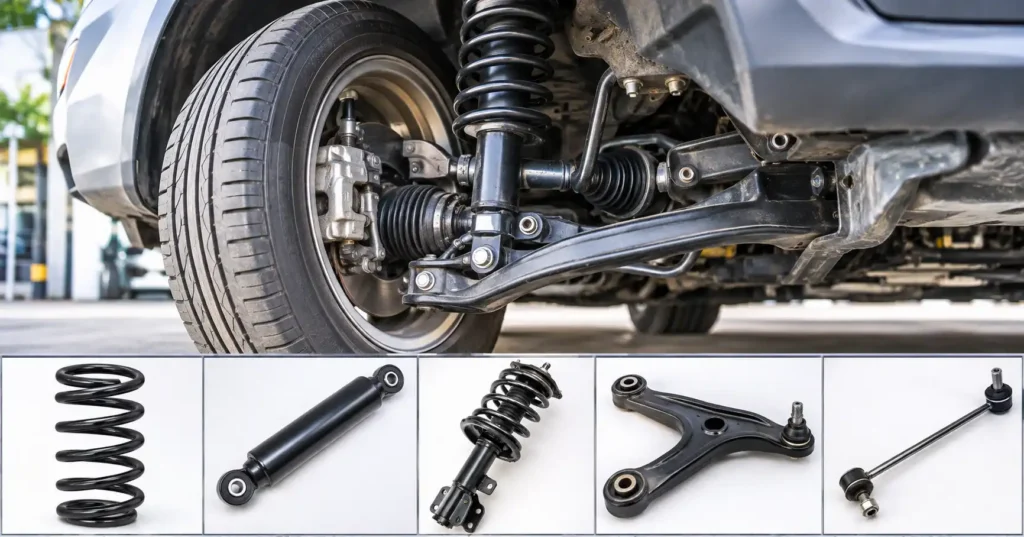
Most suspension systems share the same core parts, even though the exact layout changes from car to car. These five components matter most for everyday driving.
1. Springs
Springs carry the weight of the car and soak up impacts. Most modern cars use coil springs, which are steel coils wound around the damper or mounted separately. Older pickup trucks and some heavy vans still use leaf springs, which are stacked steel strips that flex under load. Some luxury and SUV models use air springs, which are rubber bellows filled with compressed air. Springs also set the ride height, which is the distance between the body and the road. Over time, springs can sag or crack, especially when a car regularly carries heavy loads. A sagging spring lowers one corner of the car and changes how it steers.
2. Shock Absorbers (Dampers)
Shock absorbers control how fast the springs compress and rebound. They are oil-filled tubes with a piston inside, and the resistance the piston creates is known as damping. Worn shocks let the body bounce after bumps, increase braking distance, and cause uneven tyre wear. Many mechanics recommend replacing shocks in pairs on the same axle, since both sides should behave the same way. Cars with MacPherson struts use a strut instead, which combines the spring and damper into one unit.
3. Control Arms
Control arms, sometimes called wishbones, connect the wheel hub to the car body. They allow the wheel to move up and down while keeping it aligned from side to side. Each arm has bushings at its mounting points and ball joints at the wheel end. A bent or worn control arm can cause clunks, vibration, and poor wheel alignment. Hitting a kerb hard or driving into a deep pothole is a common cause of this damage.
4. Anti-Roll Bar
The anti-roll bar, also called a sway bar, is a steel bar that links the left and right sides of an axle. When you corner, the body leans outward, which is called body roll. The anti-roll bar twists to resist that lean and keeps the car flatter through turns. It is a simple part, but it has a big effect on handling and steering response. Worn end links often cause a knocking noise over speed bumps, so this is one of the easiest faults to spot.
5. Bushings and Joints
Bushings are rubber or polyurethane pieces placed wherever metal parts meet. They cushion vibration, reduce noise, and let parts move without grinding against each other. Ball joints and tie rod ends allow movement in several directions, much like a shoulder or wrist joint. Because rubber ages, perished bushings are very common on cars more than ten years old. Polyurethane bushings last longer, but they can send more road noise into the cabin.
Types of Suspension System
Car makers choose a suspension design based on cost, packaging space, comfort goals, and the vehicle’s purpose. Broadly speaking, suspension falls into two families, dependent and independent, and several popular designs grow from those two.
1. Independent Suspension
In an independent setup, each wheel moves on its own without disturbing the wheel on the opposite side. This design improves ride comfort and grip because one wheel hitting a pothole does not upset the other. Most modern passenger cars use independent suspension at the front and often at the rear too. The trade-off is higher manufacturing cost and more moving parts to maintain over the car’s life.
2. Dependent Suspension
A dependent suspension connects both wheels on an axle with one solid beam. When one wheel rises, the other one tilts. This design is simple, strong, and cheap to build, which explains why it appears on pickup trucks, heavy vans, and many off-road vehicles. It handles heavy loads well, but ride comfort and cornering grip usually suffer on rough roads. Engineers also call this a rigid axle setup.
3. MacPherson Strut Suspension
The MacPherson strut is one of the most common designs in front-wheel drive cars. It combines the coil spring and shock absorber into a single strut assembly, which attaches to the wheel hub at the bottom and to the body at the top. Its compact layout saves space under the bonnet and keeps costs low. Because the strut also forms part of the steering pivot, the alignment can be adjusted but must be checked after any work. Its main limitation is that it cannot control wheel angles as precisely as a multi-link design.
4. Multi-Link Suspension
Multi-link suspension uses three to five individual links per wheel to position the hub accurately. Each link controls one aspect of movement, such as camber angle, toe alignment, or the forces created under braking. Engineers use this design on premium saloons, performance cars, and many SUVs because it balances comfort and handling very well. It costs more to build and repair, and workshops need proper alignment equipment to set it up correctly after any job.
5. Air Suspension
Air suspension replaces steel springs with airbags that adjust pressure electronically. A compressor and sensors control the air, so the car can raise its ride height for rough ground or lower it for motorway driving and easier loading. Many luxury SUVs and some high-end saloons use this system. The main drawbacks are repair expense, leaking airbags, and compressor failures, particularly once a car gets older.
Here is a quick comparison of the main types:
| Suspension Type | Common Use | Ride Comfort | Handling | Typical Repair Cost |
| Independent | Most modern cars | High | High | Medium |
| Dependent | Pickups, vans, off-road | Lower | Lower | Low |
| MacPherson Strut | Front-wheel drive cars | Good | Good | Low to medium |
| Multi-Link | Premium and sports cars | Very high | Very high | High |
| Air Suspension | Luxury SUVs and saloons | Very high | High | Very high |
Why Car Suspension Matters
A healthy suspension affects far more than comfort. It shapes how your car behaves in situations where safety depends on grip and control.
- Safety: Good suspension keeps the tyres in contact with the road, which shortens braking distance and helps the car stay stable in an emergency swerve.
- Comfort: It filters out vibration and harsh impacts, reducing driver fatigue on long journeys.
- Protection: It shields the chassis, steering components, and body from repeated shocks that cause cracks and wear.
- Stability: It limits body roll and sway, so the car feels planted at motorway speeds.
- Legal compliance: Suspension faults such as worn shocks or broken springs can cause an MOT failure in the UK.
Ignoring suspension wear often leads to a bigger bill later. A worn shock absorber left too long can damage tyres, bushings, and ball joints, turning a modest repair into a multi-part job.
How Suspension Affects Tyre Wear
Tyres and suspension depend on each other. The suspension sets the angle at which each tyre meets the road, and any change to that angle wears rubber unevenly. The most common pattern is feathering, where the tread edges wear into a saw-tooth shape, usually caused by incorrect toe. Camber wear shows up as one shoulder of the tyre wearing faster than the other. Cupping creates scooped dips across the tread, which often points to worn dampers letting the wheel bounce.
If your tyres wear quickly or unevenly, have the wheel alignment and suspension checked before buying new rubber. Otherwise, the new tyres will wear just as fast. Regular rotation helps, but it cannot fix a geometry problem.
Signs of Suspension Problems
Suspension problems usually develop slowly, so drivers often adapt without noticing. Watch for these warning signs:
- The car bounces more than once after hitting a bump or dip
- The vehicle pulls to one side when you brake or drive on a flat road
- Clunks, knocks, or rattles come from the wheels over speed bumps or potholes
- The steering feels loose, vague, or unusually heavy in corners
- The nose dives when braking hard or the rear squats when accelerating
- Tyres show feathering, cupping, or uneven shoulder wear
- One corner of the car sits lower than the others when parked
Some of these symptoms overlap with problems in other parts of the car. A pull or vibration can also come from brakes or the drivetrain, so a proper inspection is the only sure way to confirm the cause. If your car is nearing its test date, it is worth reading our guide on whether you can still drive a car after an MOT failure. More Read: If My Car Failed Its MOT, Can I Still Drive It? UK Rules Explained
Leaks and noises from other systems can also mislead drivers. Unusual gear changes and fluid under the car may point to a transmission problem rather than a suspension fault. More Read: Gearbox Oil Leak Symptoms: 7 Warning Signs to Watch For
Real-World Driving Experience
Mechanics regularly see the same pattern. A car that has covered many miles on rough roads often shows worn bushings, leaking shocks, and tired springs at the same time. Drivers usually describe the change as a car that feels floaty or noisy, rather than one that breaks suddenly. This gradual decline is why regular checks matter more than most owners expect.
Winter brings extra stress. Cold weather, potholes, and road salt all test the suspension, and rubber parts stiffen in low temperatures. Many drivers only discover damage after the season ends, which makes autumn a good time for a check-up. More Read: Why Winter Is the Best Time to Scrap Your Car
Maintenance Tips for Suspension
Good maintenance keeps the suspension working as designed and avoids expensive surprises. Use these habits to protect your setup:
- Check the suspension and tyres during every service, not only at MOT time
- Avoid hitting potholes, kerbs, and speed humps at speed
- Keep tyres inflated to the pressure in your car’s handbook or door frame label
- Reduce loads in the boot when they are not needed, since constant overloading wears springs and shocks faster
- Get a wheel alignment after replacing struts, control arms, or tie rod ends
- Replace worn bushings and joints before they cause clunks or uneven tyre wear
- Ask for a written inspection report when a garage quotes suspension work, so you can compare prices
Driving style matters too. Smooth braking, steady cornering, and slower speeds over rough surfaces all reduce the strain on suspension parts.
Choosing the Right Suspension Setup
When you buy a new car or upgrade an existing one, choose a setup that fits how you actually drive. A daily commuter on smooth roads benefits from a comfortable independent design with simple maintenance. A family SUV carrying heavy loads benefits from strong springs and well-damped shocks. Off-road enthusiasts may prefer a dependent axle with heavy-duty components. Drivers who want sharp handling usually choose multi-link suspension, but they should expect higher service costs.
Aftermarket upgrades such as lowered springs or stiffer dampers can change how a car feels. Before fitting them, check that the changes meet UK rules on ride height and that your insurer knows about the modification. Poorly matched parts can make the car less safe, not more capable.
Final Thoughts
The suspension system is one of the most important safety and comfort systems in your car, even though it rarely gets attention. Springs support the weight, dampers control movement, control arms and joints guide the wheels, and the anti-roll bar keeps the body steady in turns. Knowing the main types, from independent and dependent designs to MacPherson struts, multi-link layouts, and air suspension, helps you understand what your car needs and what a repair should involve.
If your suspension has worn beyond a reasonable repair, selling it may be the smarter option. Our team can help you with a sold damaged car service, and we handle the collection and DVLA paperwork for you. You can also get a quick, no-obligation price by visiting Scrap My Car UK and entering your registration.
FAQs About Car Suspension Systems
What is the main function of a car suspension?
The suspension supports the vehicle’s weight, keeps the tyres in contact with the road, and absorbs bumps for a smoother and safer ride.
How long do car shock absorbers last?
Shock absorbers often last between 50,000 and 100,000 miles, although rough roads and heavy loads can shorten that range.
What is the difference between shocks and struts?
Shock absorbers only control movement, while struts also support the spring and form part of the steering assembly.
Can I drive with a damaged suspension component?
Driving with a damaged suspension part is unsafe and can fail an MOT, so have it inspected before driving further.
Does suspension affect fuel economy?
Yes, worn or misaligned suspension can increase tyre drag and wear, which slightly reduces fuel efficiency.
How much does it cost to repair a car suspension?
Costs range from a small bushing repair to several hundred pounds for struts, control arms, or air suspension parts.
Is air suspension worth having?
Air suspension offers excellent comfort and adjustability, but repairs are expensive, so it suits drivers who accept higher upkeep.
Can a failed suspension cause an MOT failure?
Yes, excessive wear, leaking dampers, and broken springs are common MOT failure items in the UK.